I keep a close eye in the breakfast cereals market since the early 2000s, when breakfast cereals were relatively underdeveloped as a category in Greece. Together with the growth of pasteurized / “fresh” milk, breakfast cereals grew vastly during the last decade riding on the global health & wellness trend in the food industry.
The category itself has a lot of great characteristics on shelf. The 3 things I particularly like in this category is that there is a pretty clear segmentation (kids / teens / family / muesli / adult / functional), there is room for innovation and experimentation (possibly the only way to differentiate in a category that would otherwise have been a commodity) and lastly there is plenty of available facing space to communicate on pack.
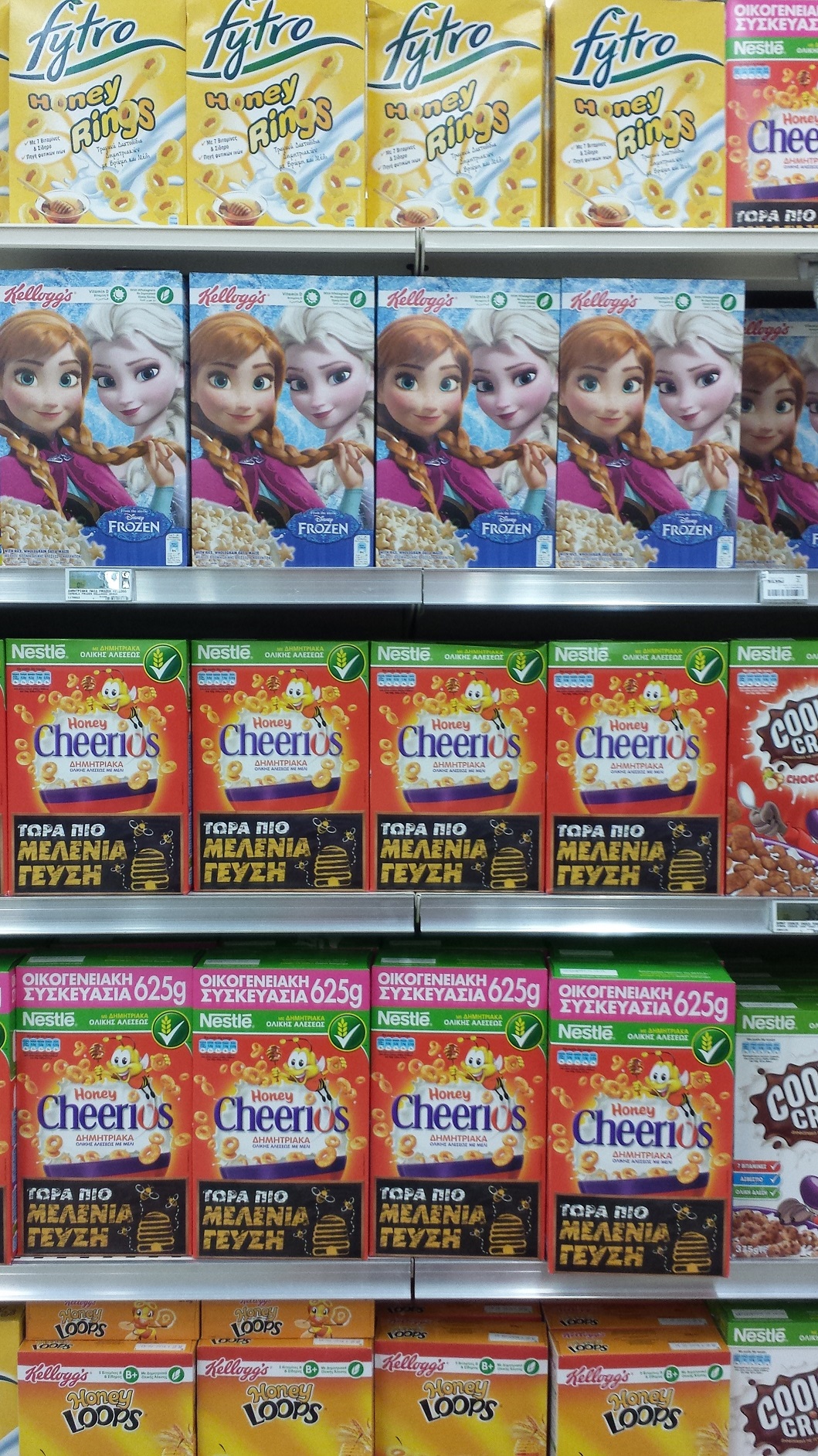
A week ago, when I visited the market, I could not help but noticing the new proposal from Kellogg’s cereals on shelf. An uncluttered packaging design featuring the cartoon characters from Disney’s movie Frozen looking straight at every shopper’s eyes! This package had been definitely disruptive and I quickly realized that something was really different. I paused and stayed a bit longer in the aisle and I observed that many shoppers added this product to their shopping trolley.
Cereal packs of most companies have a relatively standard layout. If you allow me a simplification, top ~20% of pack is used for communicating the manufacturing company and category or range benefits, the middle ~50% is for showcasing the cereals brand (and the product serving proposition) and bottom 30% to communicate promotions, partnerships, product news etc. In our case, Kellogg’s broke this rule and proceeded with a daring move to eliminate completely their brand. So, instead of an ordinary promo pack featuring Frozen in an established Kellogg’s branded product, we have the “Frozen cereals” with the Kellogg’s signature.
Pros:
- Clear and disruptive packaging on shelf – no cluttering, no lengthy marketing texts, no product claims. Just the well-known heroines of the movie Frozen, while the logos of Kellogg’s and Frozen occupy together no more that 10% of the package space
- Great leverage of the movies brand power – I assume this product sells like hot bread while on supermarket shelves and while sales may be increasing Kellogg’s people should be also happy since one of their products is winning a place in the breakfast table among the fillet of the target group (young children)
- Disney’s people would also be content with the result as they associate their movie (brand) with a healthy category and win visibility daily for their Lilliputian consumers. In this way, they also keep the branded merchandise momentum growing.
However, there are things to consider for Kellogg’s move. The fact that they chose to launch a proposition under a brand that is not theirs, is marketing counter-intuitive. They are putting a lot of effort to produce these cereals (as the cereals per se are specially made for the occasion), merchandise the packs, pay the royalties and of course bear the sales fruit. At the end of the day, one might argue that although they are building someone else’s brand and they may get away with great sales results, they barely add anything to the strength of their brand portfolio.
Is this a good move from Kellogg’s growing its sales without growing a brand? Is this a great deal for Disney receiving the royalty fees and keeping the momentum for the Frozen brand?
What I can surely say is that the hardest to find who’s benefiting the most in a win-to-win collaboration, the most probable it is that this is a real win-to-win one!


The question in the end for Kellogg is what was the purpose of co-branding, sales apart. Great results require bold moves and targetting children may just be the trick. Think about it
LikeLike